How to build a customer feedback loop for SaaS
Five steps: collect with the person attached, link to a priority, rank by who is asking, ship against a spec, and tell the people who asked. The loop closes when the customer hears back.
A customer feedback loop for SaaS has 5 steps: collect feedback with the person attached, link every piece to the priority it supports, rank priorities by who is asking and what they are worth, ship against a spec that names the files and tell the people who asked. The loop closes when the customer hears back. It compounds when their reply becomes the next signal.
Most SaaS teams have the first step and the fourth. The loop breaks in between, and it breaks again at the end, where nobody tells the customer.
Where the loop usually breaks
Feedback arrives in Slack, in support tickets, in call transcripts, in survey responses, in a spreadsheet someone keeps. Each channel holds a slice. Nobody holds the whole thing, so the same request gets counted three times in one place and zero times in another.
Then the feature ships and the people who asked for it never find out. Their mental model of the product is still the version without it. That is the silent ship, and it is the most common way a feedback loop stays open.
The fix is not another channel. It is a system where each step hands the next one what it needs.
Step 1: Collect with the person attached
Every piece of feedback needs two things: what was said, and who said it. The second is the one teams drop. A quote without a customer cannot be ranked by what the customer is worth, and it cannot be answered when the feature ships.
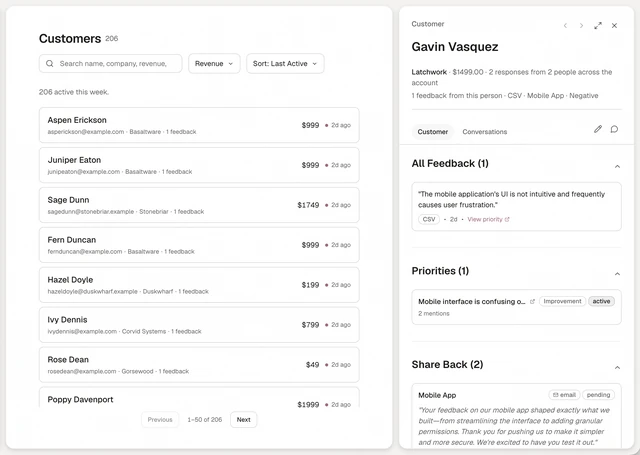
Annsa takes feedback from Slack, the website widget and in-product surveys, Intercom, call transcripts, CSV, Google Sheets, manual entry, and the API or MCP and keeps the person on every piece. Where the source carries an account, the account stays attached too.
Step 2: Link every piece to a priority
Raw feedback is not a backlog. Twelve messages about slow search are one priority with 12 pieces of evidence. The step that turns one into the other is classification: what kind of signal is this, what job does it relate to, how urgent, what sentiment.
Annsa reads each signal 4 ways: intent (Bug, Feature, Improvement, Praise), job, urgency and sentiment. Then it groups by meaning rather than wording. "Search is slow" and "results take forever" land on the same priority.
Step 3: Rank by who is asking, not how loud
Volume is a poor ranking key. It rewards the customers who write most, and it misses the silent majority who shape retention without ever writing in.
Rank instead by signal strength, which is how useful and important a piece of feedback is, and by who is behind it: the accounts, their revenue, their risk. That is what makes a priority revenue-weighted. Annsa's priorities carry that ranking with the reasoning attached, so the order can be argued with.
Step 4: Ship against a spec that names the files
A priority is a decision. A spec is what makes it buildable. The spec should carry the customer's words verbatim, the reason it matters and the files to touch, so the engineer or the coding agent starts from evidence rather than a summary.
Annsa's specs have 5 sections: What to Build, Why It Matters, Customer Voice, Files to Touch and Done When. With a GitHub connection, Files to Touch names real paths. Over MCP, Cursor and Claude Code pull the spec directly. See using Annsa with coding tools.
Step 5: Tell the people who asked
This is the step that closes the loop, and it is the one that most often does not happen, because it is manual: find who asked, find their words, write something, send it.
When the spec is marked Shipped, Annsa opens Share Back: every eligible customer listed with their email and their original quote, a note you can add and one approval. The email carries the customer's own words and a question, "Did this solve it for you?", with Yes and Not yet buttons. A yes is the outcome. A not-yet is the start of V2.
What "built" looks like after a month
You know the loop is running when the weekly read answers 3 questions without a meeting: what is rising, what shipped and who should hear about it and what is going quiet. That is the shape of Radar: retention risks, what shipped, new opportunities, Monday morning.
A checklist you can copy
- Every piece of feedback has a person or an account attached
- Every piece is linked to exactly one priority
- Priorities are ranked by signal strength and who is asking, with the reasoning visible
- Every spec quotes the customer verbatim and names the files
- Every shipped spec sends a note to the people who asked
- New feedback on shipped work comes back to you in Needs You
If the last two lines are not true, the loop is open. Start there.