Customer feedback template
The short answer
A customer feedback template is a record for each piece of feedback: the exact words, the person, the account, what it pays, the source and date, the problem underneath and the priority it links to. Pair it with a one-question ask sent right after the moment it happened.
A customer feedback template is a record you fill in for each piece of feedback, so the words, the person and the money stay together. It also gives you a short way to ask for feedback. For what the practice involves, see What is customer feedback management?.
TL;DR
- One record per piece of feedback. Their exact words, never your summary alone.
- Always note the account and what it pays. Without that you cannot count.
- Write the problem underneath, separate from the request.
- Link each record to a priority, so ten notes become one row you can rank.
- Ask with one short question, right after the moment it happened.
For feature requests only, use the feature request template. This record fits any feedback.
When to use it: feedback arrives from Slack, calls, email and surveys, and you keep losing it. When not: you hear from one or two customers a month. A single list is enough.
A customer feedback template
Two parts. The record is for your team. The ask is the short message you send to get feedback.
## Feedback record (one per piece of feedback)

Inputs: raw feedback text, who said it, where it came from.
Outputs: one filled record, linked to a priority.

- Their words: "[exact text, untidied]"
- Person: [name]
- Account: [account]
- Revenue: [per month, or unknown]
- Source: [Slack | call | survey | support inbox | other]
- Date: [date]
- Problem underneath: [what they are trying to do, or what is in the way]
- Type: [bug | request | praise | question]
- Linked priority: [existing row, or "new"]
- Follow up OK: [yes, how to reach them | no]
- Told when shipped: [date, or not yet]

## A short way to ask

After a task:
"Hi [name], you [did the thing] on [day]. What were you trying to get done? One line is plenty."

After a fix:
"Hi [name], we changed [the thing] after you told us [their words]. Did it fix it?"

When someone leaves:
"Hi [name], sorry to see you go. What was the one thing that would have kept you?"

## A 3-question survey

1. "How likely are you to recommend [product] to a friend? (0 to 10)"
2. "What is the main reason for your score?"
3. "What were you trying to get done the last time you used [product]?"
How do I fill in the record?
Their words. Paste the exact text. Do not tidy it. Quote marks make it clear it is theirs. You can add your own summary in the title.
Person and account. Who said it and which account they belong to. Several people at one account count as one account.
Revenue. What the account pays each month. If you do not know, write "unknown" and fill it in later. Unknown is not zero. Fill it in for the accounts you can.
Source and date. Slack, a call, a survey, the support inbox. You will want to go back to the original, and old feedback ages.
Problem underneath. One line on what they are trying to do or what is in the way. "Add PDF export" is the request. "I rebuild this report by hand every month" is the problem. Two different requests often share one problem.
Type. Bug, request, praise or question. A bug is a broken promise, and it goes ahead of most requests.
Linked priority. The row in your ranked list this belongs to, or "new". This is what turns notes into counts.
Follow up OK. Whether you may reply. A yes lets you ask one good question later and tell them when it ships.
What does a short ask look like?
Keep it to one question, in your own voice, sent when it is fresh. The template has three versions: after a task, after a fix, and when someone leaves. For more on asking well, read how to get customer feedback without being annoying.
An example, filled in
This is an example, made up to show the level of detail.
- Their words: "I never got my invoice. My accountant keeps asking me for it."
- Person and account: Dana, Northbeam Studio
- Revenue: $49 a month
- Source and date: Support inbox, 2 Oct
- Problem underneath: Customer cannot get invoices to their accountant, so billing causes friction at renewal.
- Type: Bug
- Linked priority: Fix invoice emails that never arrive (3 accounts before this, 4 with Dana's)
- Follow up OK: Yes, dana@example.com
- Told when shipped: Not yet
And a short ask to send Dana 3 days later:
Hi Dana, you asked us 3 days ago about invoice emails. What were you trying to get done when they didn't arrive? One line is plenty.
Notice the record keeps Dana's words and the account, and the link is what gets the count to four. The ask says nothing about features. It asks about the job.
What mistakes should I avoid?
- Summaries only. Once you paraphrase, you lose the detail that makes feedback believable.
- No revenue. One loud user and three quiet accounts that pay look the same without it.
- Mixing request and problem. Keep them in separate lines, or you will build the request and miss the problem.
- Long surveys. Every extra question costs answers. One to three is plenty.
- Never closing the loop. If people never hear back, they stop telling you things.
- Filing, not linking. A record with no linked priority is a note in a drawer.
For software that does this at small-team scale, see customer feedback software for small teams. For requests specifically, use the feature request template.
How does Annsa do it?
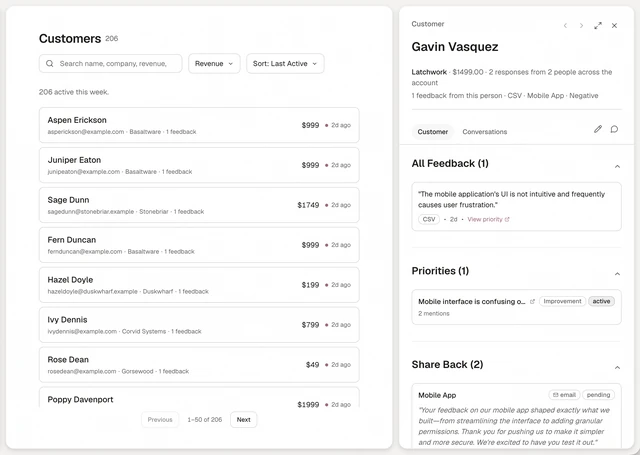
Annsa takes feedback in from Slack, Intercom, call transcripts, in-product surveys, CSV and Google Sheet imports, the API or typed in by hand. Each piece keeps the person, their exact words, the account and its revenue. Matching feedback is grouped into one priority, so five people asking five ways become one row with five accounts behind it. When the job ships, Share Back drafts a note to each person who asked. You review and send it. Annsa never contacts customers on its own.