Functional requirements
The short answer
Functional requirements say what a product must do: the behavior a person or another system can see and check, like "a customer can pause a subscription for 1 to 3 months". Speed, security and uptime are non-functional requirements. Write one behavior per line and give each a check. When agents build, they become the Done When lines in each spec.
Functional requirements say what a product must do: the behavior a person or another system can see and check. "A customer can pause a subscription for 1 to 3 months" is a functional requirement. How fast it loads or how it is secured is not; those are non-functional requirements. Each one should be testable, so you can say yes or no to "does it do this?"
TL;DR
- One behavior per requirement, written as what someone can do or see.
- Make each one testable: a person or a test can say yes or no.
- Keep them apart from non-functional requirements (speed, security, uptime) and from how it is built.
- For a team building with agents, functional requirements become the Done When lines in each spec.
When to use them: any job someone else will build, an agent included. When not: a change small enough that the requirement is the whole ticket.
A functional requirements template
One table per feature. Fill in the first column before anyone builds.
# Functional requirements: <feature name>

Why: <the problem, in the customer's words, with who asked>

| # | The <actor> can / sees... | How it is checked |
|---|---|---|
| 1 | <one behavior someone can see> | <test, staging link or screenshot> |
| 2 | <one behavior> | <check> |
| 3 | <what must NOT happen, if it matters> | <check> |

## Non-functional (kept separate)
- Speed: <e.g. loads in under 2 seconds>
- Security or access: <who can and can't do this>
- Other: <accessibility, browsers, limits>

## Out of scope
- <what this feature will not do, so nobody builds it>
What are functional requirements?
Statements of what the product does in response to an input: a click, a message, a date passing. They name the actor, the action and the result: "When an invoice is due, the account owner gets an email with a link to pay." If you cannot imagine the check that proves it, it is not a requirement yet. It is a wish.
What is the difference between functional and non-functional requirements?
Functional requirements say what it does. Non-functional requirements say how well: response time, availability, security, accessibility, what browsers it runs on. "A customer can export invoices as CSV" is functional. "The export finishes in under 10 seconds for 5,000 invoices" is non-functional. Write both, but keep them in separate lists so a change to one doesn't hide inside the other.
How do you write a good functional requirement?
- Start with who. "The account owner can...", not "The system shall allow...".
- One behavior per line. If a line has "and", it is usually two requirements.
- Use the customer's words for the outcome, then add the detail a builder needs.
- Say what does not happen, when it matters: "An annual plan shows no Pause button."
- Give each one a check: a test, a staging link or a screenshot.
Functional requirements examples
This is an example, made up to show the level of detail.
Feature: pause a subscription
- The account owner can pause a monthly subscription for 1, 2 or 3 months. Check: test.
- A paused account creates no invoice until the return date. Check: test.
- A paused account shows its return date on the billing page. Check: screenshot.
- The account owner gets an email 7 days before the subscription restarts. Check: staging link.
- An annual plan shows no Pause button. Check: screenshot.
Non-functional, kept separate: the billing page loads in under 2 seconds with a pause applied.
Where do functional requirements go?
In the document that describes the work. On a large team that might be a functional requirements document, a product requirements document or a business requirements document. On a small team it is usually the spec for one job, the habit called spec-driven development: see the spec template. The format matters less than the habit: write the behavior down before the build starts, then check it after.
Do functional requirements still matter when agents do the building?
More than before. An agent builds exactly what the spec says and fills gaps with guesses. Clear functional requirements are how you stop the guesses. Written as Done When lines ("Given a paused account, when the billing date passes, then no invoice is created"), each one becomes something the agent proves with a test or a link before you call the job done. See definition of done for AI agents.
How does Annsa help?
Annsa keeps the requirements with the work your agents pick up.
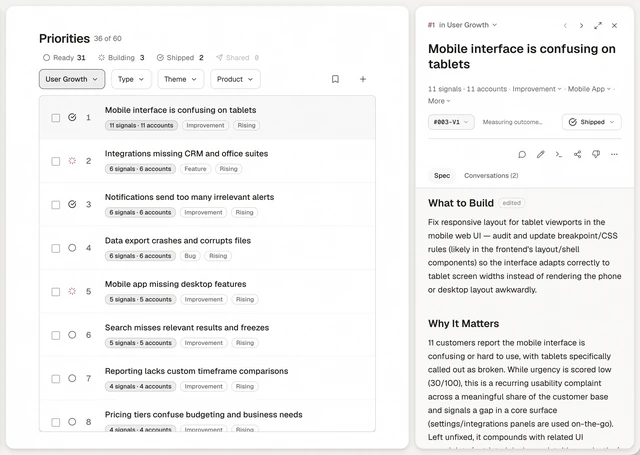
- Each priority has a spec with Problem, Evidence, What to build, Files to touch and Done When. You, your agent over MCP or Ask writes it.
- Done When lines are your functional requirements. Claude Code, Cursor, Codex and Grok connect over MCP, read them and record how each one was checked.
- The evidence stays attached: who asked, in their words, so a requirement never loses its reason.
Sources: Functional requirement and Non-functional requirement, Wikipedia.
Questions people ask.
What are functional requirements?
What is the difference between functional and non-functional requirements?
What is an example of a functional requirement?
Who writes functional requirements?
The source of direction for agent teams.
Begin with one agent and the work that matters next.