Business requirements document template
The short answer
A business requirements document (BRD) says why a piece of work is worth doing for the business and what must be true when it is done: the goal and the number it should move, who is affected, the evidence, the requirements in plain terms, scope and how success is measured. For a small team, one page is plenty.
A business requirements document (BRD) says why a piece of work is worth doing for the business and what must be true when it is done. It covers the goal, the people affected, the requirements in business terms and how success is measured. It is not the technical plan. That comes after, in a product requirements document or a spec.
TL;DR
- Lead with the business goal and the number it should move.
- Name who is affected and what they need, in their own words.
- Write requirements as outcomes the business can check, not features.
- Keep it short. For a small team, one page is plenty.
When to use it: work that needs someone else's yes, touches money or customers, or spans more than one team. When not: a small change where the goal fits in the ticket title.
A business requirements document template
Copy it, delete the parts you don't need, and fill in the rest before anyone builds.
# Business requirements: <name of the work>

Owner: <name> | Decides: <name> | Date: <date>

## Goal
<What the business gets, in 1 or 2 sentences.>
Measure: <the number it should move, and by when>

## Who is affected
- <customers / team / partners>: <what changes for them>

## Evidence
- <requests in the customer's words, accounts, revenue, or the cost of doing nothing>

## Business requirements
1. <What must be true, in plain terms, that you can check after launch>
2. <...>

## Scope
- In: <...>
- Out: <...>

## Success measure
- <what you will look at, and when>

## Risks and open decisions
- <risk or decision> | Decides: <name> | By: <date>
What goes in a business requirements document?
Goal. One or two sentences on what the business gets, and the number it should move: "Cut cancellations from customers who only need a break."
Who is affected. Customers, your own team, partners. For each, what changes for them.
Evidence. Why now: the requests in the customer's words, the accounts and the revenue, or the cost of doing nothing.
Business requirements. What must be true, in plain terms: "Customers who want a break can keep their account without paying." Each one should be something you can check after launch.
Scope. What is in, and what is out, so nobody builds the out list.
Success measure. How you will know it worked, and when you will look.
Risks and decisions. What could go wrong, and which calls are still open and whose they are.
What is the difference between a BRD, a PRD and a functional requirements document?
A BRD says why and what the business needs. A product requirements document turns that into what the product must do. A functional requirements document (or a spec) lists each functional requirement a builder will check against. Large companies keep all three. A small team usually keeps one page per job that covers the why, the what and the checks.
A business requirements document example
This is an example, made up to show the level of detail.
Pause instead of cancel
Goal. Keep customers who want a break. Measure: cancellations that give "too busy" or "seasonal" as the reason, down by half in 3 months.
Who is affected. Monthly customers (can pause), support (fewer cancellation emails), finance (fewer invoices during pauses).
Evidence. 3 accounts asked in their words: Northbeam Studio, Fieldnote and Tallow & Co, about $200 a month together. 11 cancellations last quarter gave a seasonal reason.
Business requirements.
- A monthly customer can stop paying for up to 3 months without losing their data.
- The customer knows when billing restarts, before it does.
- Annual plans are not affected.
Out of scope. Pausing annual plans. Partial refunds.
Success measure. Seasonal cancellations, checked monthly from the date it ships.
Open decision. Cap pauses at one a year? Decides: Cat, by Friday.
Does a small team need a business requirements document?
Not as a separate document. What a small team needs is the habit inside it: the goal and the number, the evidence, and what must be true when it is done. Put those at the top of the spec for the job, and skip the rest unless someone outside the team has to sign off.
How does Annsa help?
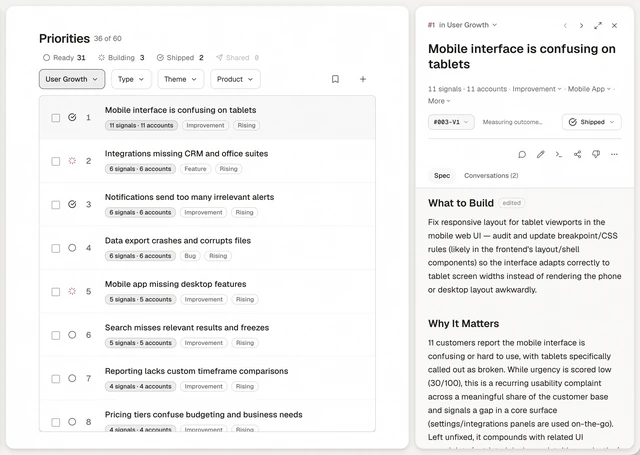
Annsa keeps the business case with the work your agents build from.
- Bets hold the goal and the number. Priorities sit on bets, so the why is one click from the work.
- Evidence is attached to each priority: who asked, in their words, with their accounts and revenue.
- Each priority's spec carries the requirements as Done When lines your agents (Claude Code, Cursor, Codex and Grok, over MCP) check before they call it done.
Sources: Business requirements and Product requirements document, Wikipedia.
Questions people ask.
What is a business requirements document?
What is the difference between a BRD and a PRD?
What should a business requirements document include?
Does a startup need a BRD?
The source of direction for agent teams.
Begin with one agent and the work that matters next.