In practice
"Customers want faster export" is a summary. "Customers export because they don't trust the reporting" is an insight. The second one can change what you build: you fix the reports instead of speeding up the export.
An insight isn't raw feedback or a metric. Both are inputs.
How to get one
- Pull feedback from every place it lands: tickets, calls, surveys, reviews.
- Group it by the problem underneath, not the words used.
- Count the people and companies behind each group.
- Ask why the pattern exists. Go back to a few customers and check.
- Write the insight as one sentence that would change a decision. If it changes nothing, it's still a summary.
Common mistakes
- Calling a count an insight. "40 people mentioned export" is a finding.
- Reading only the loudest channel, usually support, and missing customers who never file tickets.
- Stopping at the insight. If it never reaches the roadmap, it was a report.
What changes in AI-first products
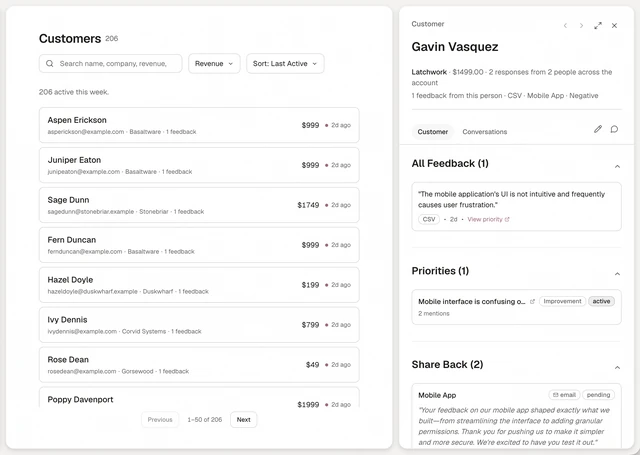
Finding patterns across 400 comments got much faster. Deciding whether a pattern matters is still a judgment about what the business cares about. With several agents building at once, a missed insight gets built around four times. Annsa groups feedback into priorities, shows each one with the quotes and companies behind it, and ranks them: broken things first, then what customers asked for, then ideas. You read the evidence and make the call; your agents work from the same list.
See how Annsa does it: AI assistant for business →