In practice
The path is simple: a customer says something, it reaches the person making the decision, something ships and the customer hears about it. Most teams complete the first 3 steps and miss the return.
Collecting feedback isn't a loop on its own. If nothing goes back to the customer, you built a funnel.
Say a customer writes in that exports lose their saved filters. In a working loop, that message reaches the person who ranks the work, it is weighed against everything else, the fix ships and the customer gets a short note saying it is fixed. A broken loop stops after the second step: the message goes into a spreadsheet, and the customer never hears again.
The loop has 4 jobs: collect what customers say with their exact words, decide what to do, build it and tell the people who asked. Each is a place where the loop can break. The last one is the easiest to skip, because no tool forces you to do it.
A feedback loop isn't a survey program, a feedback board or a net promoter score. Those collect. It also isn't release notes, which speak to everyone. And a loop isn't closed when you tell customers you are listening. It closes when a specific person learns what happened to the thing they raised, including when the answer is no. This entry covers the whole loop. Closing the loop is its last step.
How to run a loop
- Gather feedback from every place it arrives, with who said it and their exact words.
- Decide what to build and what to say no to. Both are answers.
- Build it and check that it works.
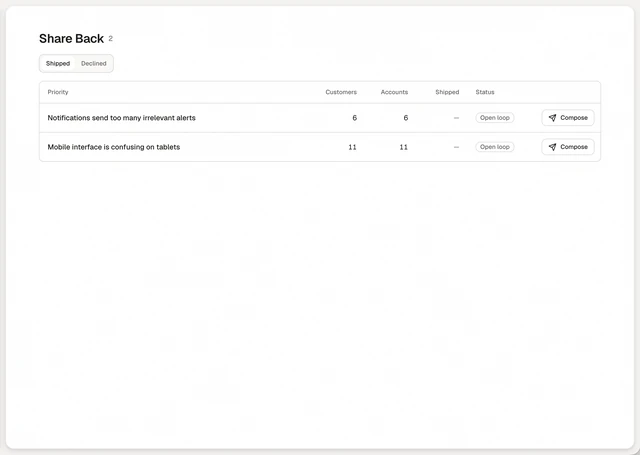
- Tell each person who asked, in a note that names their request.
The guide on the customer feedback loop walks through each stage, and the post on how to close the loop covers the last one.
Common mistakes
- Stopping at collection. A full inbox is not a loop.
- Telling everyone in one announcement and nobody in particular. The customer who asked wants to know their request was heard.
- Replying only to the good news. A clear no, with a reason, also closes a loop.
- Throwing away the customer's words when you summarize. The exact words are the evidence.
- Letting it take months. The longer the gap between the ask and the answer, the less the customer remembers asking.
Why it matters for founders and small teams
The return step earns the next piece of feedback. Customers who know you listened are more likely to send useful signal again.
The reply is what earns the next piece of feedback. Customers who hear back keep telling you things. Customers who don't go quiet, and you lose the signal you rely on.
It also keeps the product honest. When you have to tell a customer what happened to their request, you notice which ones fell through.
What changes in AI-first products
The parts that changed are speed and volume. Sorting incoming feedback into groups, drafting a note to each person who asked and checking whether the work matches the request can all be done by software, and no longer need a person's afternoon.
What didn't change is the judgment at the center: deciding what matters, and deciding what to say to a customer. A note sent without a person reading it can say the wrong thing to the wrong person. The cheap steps are now cheaper, but the loop still needs a person to make the call and a person to answer for what is sent.
See how Annsa does it: Share Back →