Customer insight questions
The short answer
Ask your customer evidence five questions each week: what is rising, what broke, who is at risk, what the last ship changed and what the biggest accounts are asking for. A good answer names accounts, quotes exact words and ends in a decision. If there is no evidence, say so.
Customer insight questions are the handful of questions you put to your customer evidence every week. Asked on a schedule, they show what is rising, what broke, who might leave and whether your last ship helped. Part of customer feedback analysis; this is the weekly version. For the idea, see What are customer insights?. These are questions for your evidence. For questions to ask a person, see product discovery.
TL;DR
- Ask the same short list each week, so changes stand out.
- Five questions: what is rising, what broke, who is at risk, what did the last ship change and what are the biggest accounts asking for.
- A good answer names accounts, quotes exact words and ends in a decision.
- If the answer has no evidence, say so. Do not smooth it over.
- 15 minutes is enough.
When to use it: feedback keeps coming in and you are not sure what it adds up to. When not: you have a handful of customers. Talk to them.
The weekly questions
Run them on a fixed day. Write the answers down, even in a line, so next week you can compare.
# Weekly customer insight questions

Inputs: the last 7 days of customer evidence (feedback, requests, bugs, shipped work), account revenue.
Outputs: an answer to each question with accounts and exact quotes, then one decision.

1. What is rising?
   Good answer: the theme, the number of accounts (and last week's), one exact quote.
2. What broke?
   Good answer: what stopped working, who hit it, when and whether it is still happening.
3. Who is at risk?
   Good answer: the account, what it pays, the words or event that worries you.
4. What did the last ship change?
   Good answer: before and after. Fewer reports, a quote, or "no change".
5. What are the biggest accounts asking for?
   Good answer: top accounts by revenue, what each asked for and whether it matches the most common ask.

If there is no evidence, write "no evidence". Do not guess.

Decision this week: [build | look closer | tell someone | leave it], because [reason].
Date: [date]
What does a good answer look like?
What is rising? Which requests or complaints came up more this week than last. A good answer names the theme, the count of accounts and one exact quote. "Invoice emails: 4 accounts, up from 1. 'I never got my invoice.'" A weak answer says "people seem frustrated about billing".
What broke? Anything that used to work and does not now. A good answer says who hit it, when and whether it is still happening. It separates a bug from a missing feature, because a broken thing goes ahead of most requests.
Who is at risk? Accounts that said they might leave, went quiet, or hit a problem twice. A good answer names the account, what they pay and the words or event that worries you. Use their behavior, not a hunch.
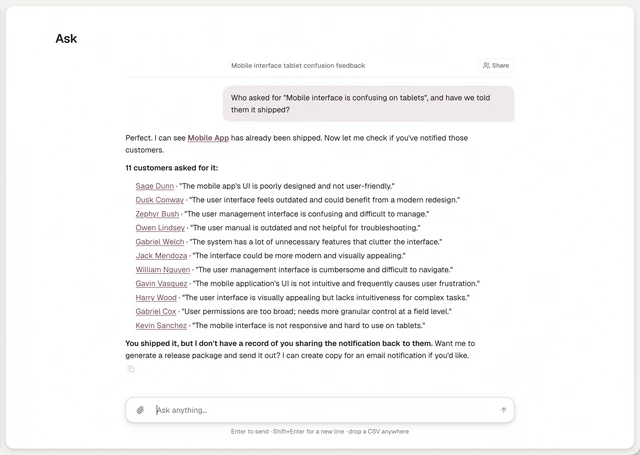
What did the last ship change? Whether the thing you shipped fixed the problem. A good answer compares before and after: fewer reports, a quote that says it helped, or no change. "We think it helped" is not an answer.
What are the biggest accounts asking for? The top accounts by revenue, and what each asked for in the last month. A good answer lists the account, the amount and the ask. It also flags when the biggest account's ask differs from the most common one.
What if I have too little evidence?
Say so. "Nothing new from the top five accounts this week" is a real answer. Zero feedback is not the same as no problem, so check whether you are collecting from the right places.
What do I do with the answers?
End each with a decision: build, look closer, tell someone, or leave it. If an answer changes the order of your list, change it. If it shows a customer waiting on a fix that shipped, send them a note. For more depth on reading feedback, see customer feedback analysis.
An example, filled in
This is an example, made up to show the level of detail. Say a four-person team with 40 customers, on a Monday.
- What is rising? Report export: 5 accounts, up from 2 last week. "I copy the list into a doc by hand." (Dana, Northbeam Studio)
- What broke? Invoice emails not arriving. 4 accounts, the last on Friday. Still happening. This is a bug.
- Who is at risk? Northbeam Studio, $49 a month. Dana raised invoices twice and asked about canceling.
- What did the last ship change? Mobile layout shipped on 10 Oct. Reports of "hard to read on my phone" dropped from 4 to 0. One quote: "Much better, thanks."
- What are the biggest accounts asking for? Harbor and Reed, $400 a month: single sign-in. Brightside, $320: report export. The top ask differs from the most common one.
- Decision: Fix invoice emails first. Tell Dana. Keep report export next. Look closer at single sign-in.
Notice the answers have names, counts and quotes, and the last line is a decision.
What mistakes should I avoid?
- Asking different questions each week. You lose the trend.
- Answers without accounts. "Some customers" cannot be checked.
- Mistaking volume for importance. The loudest request is not always the biggest account's.
- Counting silence as good news. Check you are collecting from where customers talk.
- No decision at the end. An insight that changes nothing is trivia.
- Trusting a smooth summary. Ask for the quotes behind it.
Inputs and outputs for an agent: it takes your customer evidence for the last week and returns an answer to each question, with accounts and exact quotes, and a suggested decision for a person to confirm.
How does Annsa do it?
Ask in Annsa answers questions about your evidence: feedback, priorities, specs and what shipped. Answers come back with the accounts and the customers' exact words, so you can check them. You can ask these five questions in plain language each week, or have your agent ask over MCP with annsa.ask. For example:
- "Which problem gained the most accounts in the last 7 days?"
- "What broke this week, and is it still happening?"
- "Which accounts raised a problem twice or asked about canceling?"
- "Did reports of the problem we shipped on 10 Oct go down?"
- "What did our 5 biggest accounts ask for this month?"
Asking is read-only. You decide what changes. See how to ask Annsa and how Ask works in the product.