Skip to content

Glossary · Product requirements

What are product requirements?

Product requirements describe what a product must do and the limits it must work within.

In practice

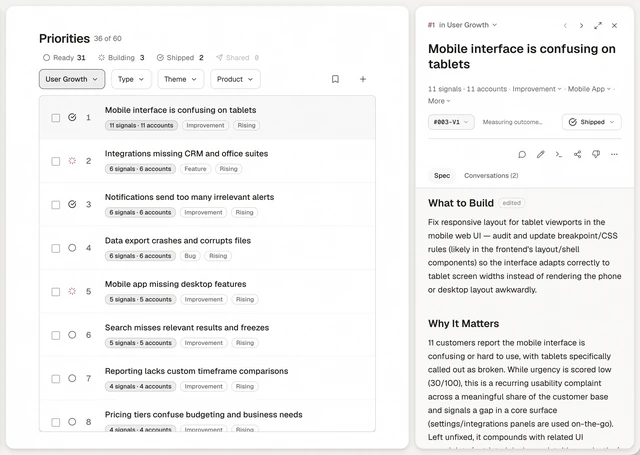
They cover behavior, important edge cases and what success looks like without dictating the implementation. Good requirements say what must be true and make clear which decisions are still open.

They aren't a design or technical plan. Those follow from the requirements.

Why it matters for founders and small teams

Requirements are where you resolve ambiguity cheaply. Anything left vague is usually decided mid-build by whoever is closest to the work.

Questions people ask.

Q1

What is the difference between product requirements and a PRD?

Product requirements are the content: what the product must do and the limits it works within. A PRD is a document that holds them, usually with the problem, goals and scope. You can have requirements without writing a formal PRD.
Q2

What makes a good product requirement?

It is specific, testable and about the outcome, not the build. A reader can tell when it is met. It names the customer problem it answers, and it says which decisions are still open instead of hiding them.
Q3

Who writes product requirements?

Usually a product manager, or the founder in a small team. Engineers, designers and support should read them early. The best ones start from what customers said, so keep the original words and the number of accounts beside each requirement.

Last reviewed 2026-08-21

The source of direction for agent teams.

Begin with one agent and the work that matters next.